♀︎ Venus
The morning and evening star, cool and moist, called the lesser fortune. Venus draws things together: love and desire, beauty, pleasure, music and the arts, friendship and the making of peace.
Correspondences
- Day
- Friday, and the first hour after sunrise on that day. See the planetary hours.
- Works
- Love, friendship, beauty, art and reconciliation.
- Metal
- Copper. See alchemy.
- Number
- 7, with a magic square of 7 by 7. Draw on it with the sigil maker.
- Colours
- Green and pink. See candles.
- Incense
- Rose; all flowers, with sandalwood. The Heptameron gives costus for its day. See incense.
- Names
- Greek Aphrodite, or Phosphoros; Hebrew Nogah; Arabic al-Zuhra.
- Greek vowel
- Eta, in the scheme that gives the seven vowels to the seven spheres.
Angels and spirits
- Angel of the day
- Anael, in the Heptameron. See Angels.
- Intelligence
- Hagiel
- Spirit
- Kedemel
- Olympic spirit
- Hagith
- On the Tree
- Netzach, Victory, the seventh sephira. Divine name YHVH Tzabaoth; archangel Haniel. The Golden Dawn's archangel of the sphere is not always the Heptameron's angel of the day.
- In the Goetia
- Dukes, whose seals are made in copper. Agares, Valefor, Barbatos, Gusion, Eligos, Zepar, Bathin, Sallos, Aim, Bune, Berith, Astaroth, Focalor, Vepar, Uvall, Crocell, Alloces, Murmur, Gremory, Vapula, Haures, Amdusias, Dantalion.
- Gods
- Aphrodite, Venus, Astarte
Seals and characters
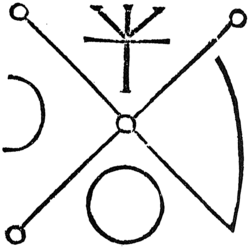 Seal of the planet
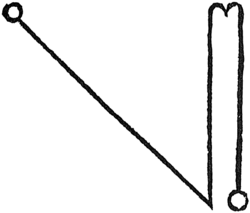 Intelligence
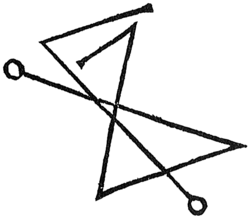 Intelligences
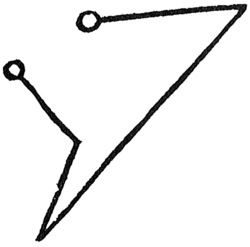 Spirit
 Hagith

The seal of the planet and those of its intelligence and spirit are from Agrippa, book two; the strip of letters is his set of the planet's characters, from book one. The last figure is the character of the Olympic spirit, from the Arbatel.
What belongs to it
- In the herbal
- Mugwort, Yarrow, Vervain, Thyme, Mint, Elder, Violet. The whole herbal.
- Agrippa's plants
- Vervain, violet, maidenhair, valerian, thyme, coriander, the rose and the myrtle, and sweet fruits: pears, figs and pomegranates.
- Agrippa's animals
- Dogs, rabbits, sheep and goats; the swan, swallow, dove and sparrow.
- Stones
- Beryl, chrysolite, emerald, sapphire, green jasper, carnelian, lapis lazuli and coral. See crystals.
- Pentacles
- 5 in the Key of Solomon. The first: “This and those following serve to control the spirits of Venus, and especially those herein…” All the pentacles.
Agrippa's lists follow the reasoning of his time, by likeness: yellow and bright things to the Sun, cold and heavy things to Saturn. Several of the plants are poisonous.
Sources and further reading
- Agrippa, Three Books of Occult Philosophy, book one, chapters twenty-three to twenty-nine, for the stones, plants and animals; chapter thirty-three for the characters; book two, chapter twenty-two, for the squares, intelligences and spirits. English translation of 1651.
- The Heptameron attributed to Peter of Abano, translated by Robert Turner (1655), for the angels and incenses of the days.
- The Arbatel of Magick, translated by Robert Turner (1655), for the Olympic spirits.
- Israel Regardie, The Golden Dawn (1937 to 1940), and Aleister Crowley, 777 (1909), for the sephiroth, divine names and archangels.
- Claudius Ptolemy, Tetrabiblos, book one, for the natures of the planets; William Lilly, Christian Astrology (1647).
- The Greek vowels of the planets are given in ancient sources including Nicomachus of Gerasa; see Joscelyn Godwin, The Mystery of the Seven Vowels (1991).

