Oracle
Tarot
Seventy-eight cards: twenty-two trumps for the large turns of a life, and four suits for its daily business. Learn how the deck is built and most of the meanings follow.
The meanings here are for the Rider-Waite-Smith deck of 1909 and the many decks drawn after it. About half the cards will come out reversed; read the second meaning, or ignore reversals if you prefer, as many readers do.
How the deck is built
The Major Arcana are the twenty-two trumps, numbered 0 to 21, from the Fool to the World. In a reading they mark what is weighty: turning points, lessons, forces larger than the day's events.
The Minor Arcana are fifty-six cards in four suits, each running from Ace to Ten with four court cards. The suit tells you which part of life is speaking and the number tells you how far the matter has gone.
| Suit | Element | Part of life |
|---|---|---|
| Wands | Fire | Will, work, enterprise, what you want to do |
| Cups | Water | Feeling, love, friendship, imagination |
| Swords | Air | Thought, speech, conflict, truth |
| Pentacles | Earth | The body, money, craft, home |
| Number | Stage | Number | Stage |
|---|---|---|---|
| Ace | The seed; a gift or an opening | Six | Harmony restored; giving and passage |
| Two | Balance, a pairing, a choice | Seven | Testing and taking stock |
| Three | First growth and first results | Eight | Movement and steady effort |
| Four | Stability, rest, a holding still | Nine | Nearly there; the matter at full strength |
| Five | Disturbance, loss, contest | Ten | Completion, and the weight of it |
The court cards are people, or ways of acting. The Page is the student and the messenger; the Knight goes after the thing; the Queen has mastered the suit inwardly, and the King outwardly. Let a court card land first on a real person in the question, and only then on a side of yourself.
The twenty-two trumps
The four suits
Three spreads
One card. A card a day, drawn in the morning and looked at again at night, teaches the deck faster than any book.
Three cards. Past, present and what is coming; or the situation, the obstacle and the advice. Decide what the three places mean before you draw.
The Celtic Cross, as A. E. Waite gave it in 1910, uses ten cards. The first covers the question: the matter as it stands. The second crosses it: what works against it. The third crowns it: the best that can be reached. The fourth lies beneath: the foundation. The fifth is behind: what is passing. The sixth is before: what is coming. Then four in a column beside them: yourself; your house, meaning the people and conditions around you; your hopes and fears; and what will come.
Reading well
- Ask an open question. “What should I understand about this job?” reads better than “Will I get it?”
- Look before you look anything up. Say what is happening in the picture, and notice what your eye went to first.
- Read the cards together. Count the suits and the trumps: many Cups make it a matter of feeling, many trumps make it weighty, no Pentacles and nothing is yet real.
- Write it down with the date. The reading you check a month later is the one that teaches you.
Where it comes from
Tarot cards appear in northern Italy in the 1440s as a card game with a fifth suit of picture trumps; the hand-painted decks made for the Visconti and Sforza of Milan survive. The game, tarocchi, spread to France and is still played. There is no sign that anyone told fortunes with the cards for the first three hundred years.
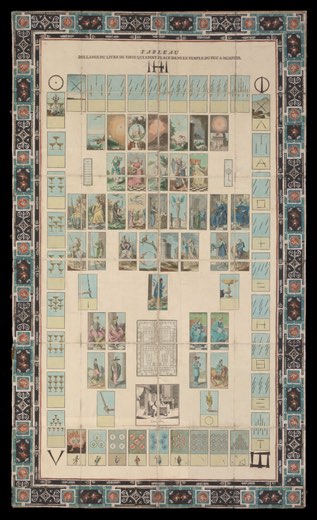
In 1781 the French scholar Antoine Court de Gébelin declared the trumps a lost book of Egyptian wisdom. He was wrong, and the idea made the tarot what it is. Etteilla published the first method of reading it and the first deck made for the purpose. In 1856 Éliphas Lévi tied the twenty-two trumps to the twenty-two Hebrew letters, and from there to the Tree of Life. The Hermetic Order of the Golden Dawn built that into a full system of planets, signs and elements, and two of its members made the decks most people now use: Arthur Edward Waite, with the artist Pamela Colman Smith, in 1909, and Aleister Crowley, with Lady Frieda Harris, in the Thoth deck.
Pamela Colman Smith's great change was to draw a scene on every numbered card, where older decks show only six cups or nine swords. Her pictures are why the deck can be read by looking.
Sources and further reading
- Arthur Edward Waite, The Pictorial Key to the Tarot (1910), which is in the public domain.
- Michael Dummett, The Game of Tarot (1980), for the history of the cards as a game.
- Ronald Decker, Thierry Depaulis and Michael Dummett, A Wicked Pack of Cards: The Origins of the Occult Tarot (1996).
- Rachel Pollack, Seventy-Eight Degrees of Wisdom (1980 to 1983), the standard modern guide to reading.

