The Goetia · Spirit 64 of 72
Haures, or Hauras, or Havres, or Flauros
- Rank
- Duke. Seal in copper; may be bound from sunrise until noon, in clear weather.
- Legions
- 36
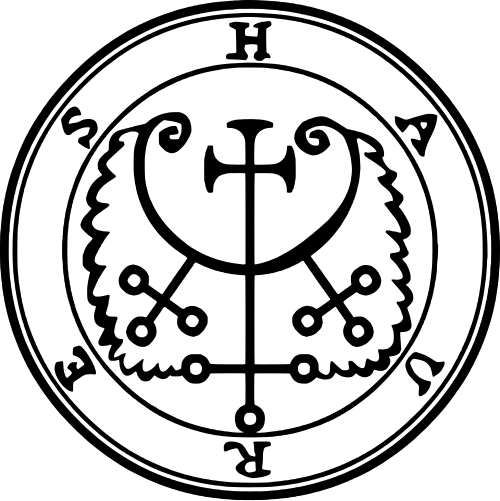
The Sixty-fourth Spirit is Haures, or Hauras, or Havres, or Flauros. He is a Great Duke, and appeareth at first like a Leopard, Mighty, Terrible, and Strong, but after a while, at the Command of the Exorcist, he putteth on Human Shape with Eyes Flaming and Fiery, and a most Terrible Countenance. He giveth True Answers of all things, Present, Past, and to Come. But if he be not commanded into a Triangle, △, he will Lie in all these Things, and deceive and beguile the Exorcist in these things, or in such and such business. He will, lastly, talk of the Creation of the World, and of Divinity, and of how he and other Spirits fell. He destroyeth and burneth up those who be the Enemies of the Exorcist should he so desire it; also he will not suffer him to be tempted by any other Spirit or otherwise. He governeth 36 Legions of Spirits, and his Seal is this, to be worn as a Lamen, etc.
- From
- The Lesser Key of Solomon: Goetia (1904), edited by S. L. MacGregor Mathers and Aleister Crowley
- Status
- Public domain. Read it in the original.
Working out the correspondences
The grimoire gives no day, colour or incense for any one spirit. What it does give is a metal for each rank, and every metal has its planet. A duke's seal is made in copper, the metal of Venus. Working from that, Haures would be approached on a Friday, in the hour of that planet, with a green candle and rose as incense.
The colours and incenses are the ones this book gives for each planet under candles and incense. Lists published by modern practitioners differ from this and from one another, most of all for earls, presidents and knights, so treat it as a starting point and not as tradition.
Offerings chosen for this spirit in particular, and the short chants called enns, come from modern demonolatry and are not reproduced here. The r/DemonolatryPractices community keeps current lists.
The description is given as printed, as a historical document.

