Oracle
Lenormand
Thirty-six small cards with plain pictures: a ship, a house, a fox, a key. They are read like words in a sentence, and they answer practical questions bluntly.
Lenormand cards are not read reversed and are seldom read alone. Draw three and read them as one sentence, the middle card being the subject.
The thirty-six cards
Each card carries a small playing card, a leftover from the game the deck began as. Some readers use the insets: hearts for feeling, clubs for trouble, and court cards for people.
How it is read
In pairs. The first card is the thing and the second describes it. Ship and Coffin: a journey cancelled. Coffin and Ship: grief that moves on, or an inheritance from abroad. Letter and Ring: a contract. Fox and Bear: trouble with a boss, or a job in finance. Order matters.
In a line of three or five. Read the middle card as the heart of the matter, the cards on either side as what describes it, then the two ends together as a summary.
The square of nine. Three rows of three around a central card. The middle column is the present, the left the past, the right what is coming; the top row is what is in mind and the bottom row what is underfoot. Read the corners together and the diagonals through the centre.
The Grand Tableau. All thirty-six cards are laid out, in four rows of eight with four beneath, or four rows of nine. Find the card that stands for the person asking, the Man or the Woman. What lies near them is close in time or weight, and what lies far is distant. Cards to their left are behind them, to their right ahead, above them on their mind, below them under their control. Then find the card for the subject of the question, the Heart for love, the Fish for money, the Anchor or the Fox for work, and see what touches it.
Good and bad neighbours. Clouds, Coffin, Scythe, Mice, Mountain and Cross darken what they touch; Sun, Stars, Clover, Bouquet and Key lighten it. The Clouds card has a dark side and a light side: whatever lies on the dark side is the thing in doubt.
Where it comes from
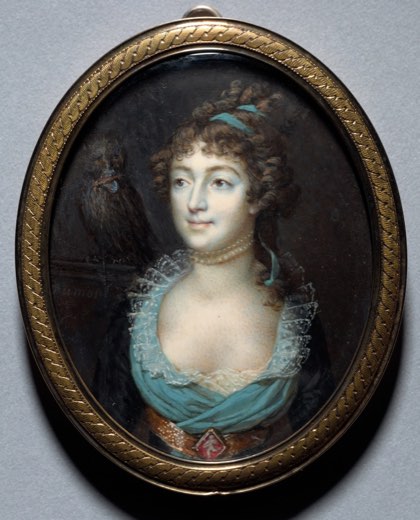
The deck began as a parlour game. About 1799 Johann Kaspar Hechtel of Nuremberg published Das Spiel der Hoffnung, the Game of Hope: thirty-six picture cards laid in a square as a board and raced across with dice, with a note that they could also be used for telling fortunes. Marie Anne Lenormand, the most famous fortune-teller of Napoleonic Paris, died in 1843, and within a few years publishers were selling Hechtel's cards under her name. She never used them.
Compared with the tarot, Lenormand is concrete. Tarot asks what a situation means; Lenormand says what is in it.
Sources and further reading
- Johann Kaspar Hechtel, Das Spiel der Hoffnung (Nuremberg, about 1799); a copy is in the British Museum.
- Ronald Decker, Thierry Depaulis and Michael Dummett, A Wicked Pack of Cards (1996), on Mademoiselle Lenormand.
- Caitlín Matthews, The Complete Lenormand Oracle Handbook (2014).
- Andy Boroveshengra, Lenormand Thirty Six Cards (2014).

