Guides
Hermeticism
The tradition that stands behind most of Western magic, alchemy and astrology: a body of writings from Roman Egypt, spoken in the voice of Hermes Thrice-Great, teaching that the cosmos is alive, that mind is its root, and that a human being can know God by knowing themselves.
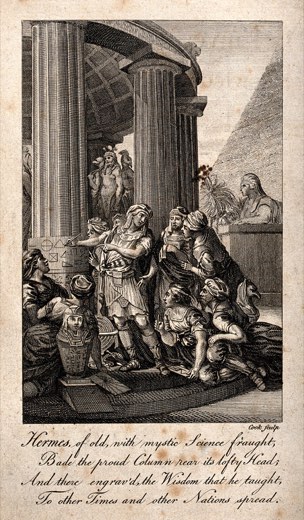
Hermes Trismegistus
In Egypt under Greek and then Roman rule, the Greek god Hermes was identified with Thoth, the ibis-headed god of writing, measurement and magic. The joint figure was called Trismegistos, “thrice greatest”, a Greek rendering of an Egyptian title of Thoth. He was imagined as an ancient sage, and books of wisdom were written under his name. No such person wrote them; the authors were Greek-speaking Egyptians of the first three centuries of our era, drawing on Platonism, Stoicism, Jewish thought and Egyptian temple religion.
The writings
Scholars sort the Hermetica into two kinds.
The philosophical Hermetica are dialogues in which Hermes teaches his pupils Tat and Asclepius, or is himself taught by the divine Mind.
- The Corpus Hermeticum, seventeen Greek treatises. The first, Poimandres, is a vision of creation and of the soul's descent through the seven planetary spheres and its return.
- The Asclepius, surviving in Latin, which contains the famous passage on making gods: drawing divine powers into statues by rites, herbs and music.
- Fragments kept by the anthologist Stobaeus, and Coptic texts found at Nag Hammadi in 1945, including The Discourse on the Eighth and Ninth, a record of an initiation.
The technical Hermetica are practical: astrology, the sympathies of plants and stones, alchemy and magic. They are older in origin and were always the larger part. The fifteen fixed stars come from this side of the tradition.
What they teach
- God is Mind, the source of all, and the cosmos is God's living image, a second god. Nothing in it is dead.
- The human being is double: mortal in body, immortal in the essential self, which is of the same nature as the divine Mind.
- The soul descended through the spheres of the seven planets, taking on a quality from each, and at death or in ecstasy it gives each back on the way up.
- Salvation is knowledge, gnosis: a direct knowing of God, reached through reverence, self-knowledge and rebirth in mind. Ignorance of God is the only real evil.
- All things are linked by sympathy, which is why what is done here can reach what is above.
Unlike some Gnostic contemporaries, the Hermetists did not think the world evil. It is beautiful, and contemplating it is a road to its maker.
The Emerald Tablet
The most quoted Hermetic text is a dozen cryptic lines that first appear in Arabic, in a book of the eighth or ninth century attributed to Apollonius of Tyana. It became the creed of the alchemists. Isaac Newton's translation begins:
'Tis true without lying, certain and most true.
That which is below is like that which is above
and that which is above is like that which is below
to do the miracles of one only thing.
“As above, so below” is the short form. It states the principle that makes astrology, talismans and alchemy thinkable: the great world and the small one mirror each other. See alchemy.
Lost and found
The Asclepius was known through the Middle Ages, and the technical Hermetica passed into Arabic, where Hermes was identified with the prophet Idris. In 1460 a manuscript of the Greek Corpus reached Florence, and Cosimo de' Medici ordered Marsilio Ficino to put Plato aside and translate it first. Ficino and his age believed Hermes had lived in the time of Moses and foreseen Christianity, and that belief gave Renaissance magic its confidence: Pico, Agrippa, Bruno and Dee all worked in its light.
In 1614 the scholar Isaac Casaubon showed from the Greek that the texts were written in the early Christian centuries. The prestige faded among the learned, but the tradition lived on in alchemy, Rosicrucianism and Freemasonry, and came down to the Hermetic Order of the Golden Dawn in 1888.
The Kybalion
Many people meet Hermeticism through The Kybalion, published in Chicago in 1908 by “Three Initiates” and its seven principles: mentalism, correspondence, vibration, polarity, rhythm, cause and effect, and gender. It is almost certainly the work of William Walker Atkinson, a writer of the New Thought movement, and its ideas are those of 1900s America: mind power, vibration and mental polarity. Only the principle of correspondence comes straight from the old texts. It is a worthwhile book of its own kind. It is not an ancient source and it is not a summary of the Hermetica.
Where to begin
Read the Corpus Hermeticum itself; it is short. Brian Copenhaver's Hermetica (1992) is the standard English translation, and Clement Salaman's The Way of Hermes a more readable one. G. R. S. Mead's version of 1906 is in the public domain. Then try the practice the texts themselves recommend: a prayer of thanks at sunrise facing east and at sunset facing west, and silence.
Read more: The Corpus Hermeticum: The Book That Relaunched Magic, at The Occult Living Room.
Sources and further reading
- Brian P. Copenhaver, Hermetica (1992).
- Garth Fowden, The Egyptian Hermes (1986).
- Frances A. Yates, Giordano Bruno and the Hermetic Tradition (1964).
- Wouter J. Hanegraaff, Hermetic Spirituality and the Historical Imagination (2022).
- Philip Deslippe, editor, The Kybalion: The Definitive Edition (2011), for its authorship.

