Guides
Alchemy
The art of perfecting matter: turning base metal into gold, making the medicine that cures all ills, and, for many who practised it, perfecting the one who does the work.
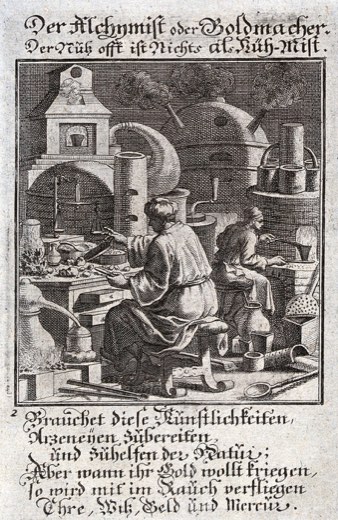
A short history
Egypt. Alchemy begins in Greek-speaking Egypt in the first centuries of our era, where the workshop recipes of dyers and goldsmiths met Greek philosophy. Its first great writer, Zosimos of Panopolis, around the year 300, already describes it as a work on the soul as much as on metal, and tells of visions of a priest dismembered and remade in a bowl-shaped altar. He credits much of his apparatus to an earlier teacher, Maria the Jewess, whose water bath is still called a bain-marie.
The Islamic world. From the eighth century alchemy was translated into Arabic and transformed. The vast body of writing under the name of Jabir ibn Hayyan taught that all metals are made of two principles, sulphur and mercury, in different proportions and purities. The physician al-Razi classified substances and equipment with a chemist's care. The words alchemy, alcohol, alkali and elixir are all Arabic.
Latin Europe. Translation into Latin began in 1144. By the fourteenth century alchemy had its own literature of allegory and emblem: green lions, red kings, the royal wedding. In the sixteenth, Paracelsus turned it toward medicine and added a third principle, salt.
The turn. In the seventeenth century Robert Boyle and Isaac Newton were both working alchemists; Newton wrote about a million words on it. Only in the eighteenth did “chemistry” and “alchemy” come apart, with gold-making left on one side of the line as a fraud or a folly.
The seven metals
| Metal | Planet | Sign | Character |
|---|---|---|---|
| Lead | ♄︎ Saturn | ♄︎ | Heavy, dull, the starting point; the metal furthest from gold |
| Tin | ♃︎ Jupiter | ♃︎ | Bright and soft |
| Iron | ♂︎ Mars | ♂︎ | Hard, hot, the metal of weapons |
| Gold | ☉︎ Sun | ☉︎ | Perfect, incorruptible; the goal |
| Copper | ♀︎ Venus | ♀︎ | Warm, beautiful, easily tarnished |
| Quicksilver | ☿︎ Mercury | ☿︎ | Liquid metal, the key to all the others |
| Silver | ☽︎ Moon | ☽︎ | The lesser perfection, the white stage |
Metals were believed to grow in the earth like plants, ripening slowly toward gold under the influence of their planets. The alchemist's claim was to do in the furnace in months what nature does in ages. The same seven run through this whole book: the hours, the herbal, the seals of the Goetia.
The three principles
- Sulphur is what burns: the soul of a thing, its heat, colour and active nature.
- Mercury is what flows and flies: the spirit, volatile and receptive, the bond between the other two.
- Salt is what remains in the ash: the body, fixity and form.
These are principles, named after the substances that show them best, and the alchemists warn constantly that their sulphur and mercury are “not the common kind”.
The Great Work
The making of the philosophers' stone was described as a sequence of colours seen in the sealed flask.
- Nigredo, the blackening. The matter is dissolved and putrefies. Death, the raven, the eclipse.
- Albedo, the whitening. It is washed and purified. The dove, the Moon, the white stone that turns metals to silver.
- Citrinitas, the yellowing. The dawn before the Sun. Later writers often leave this stage out.
- Rubedo, the reddening. The union of opposites and the finished red stone, which perfects metals into gold and, dissolved, is the elixir of life.
The steps between were counted differently by every author. George Ripley's Compound of Alchemy of 1471 gives twelve “gates”: calcination, solution, separation, conjunction, putrefaction, congelation, cibation, sublimation, fermentation, exaltation, multiplication and projection. The first few are all real laboratory operations; the last is the casting of the stone onto molten metal.
The motto solve et coagula, dissolve and bind together, sums up the whole.
What were they really doing?
Two modern pictures of alchemy are both too simple. One says it was failed chemistry by fools and frauds. The other, made famous by Carl Jung, says the alchemists were unknowingly describing the growth of the psyche and the laboratory hardly mattered.
Historians who have rebuilt the furnaces and followed the recipes have shown that the alchemists were skilled experimenters whose strange language often encodes real and repeatable reactions: a “tree” of gold really does grow in the flask. They also show that for most of its history the work was at once practical and religious. An alchemist prayed over the furnace because matter and spirit were not yet two subjects.
Spagyrics, the plant alchemy that descends from Paracelsus, is the form most people practise today: a herb is separated into its oil, its spirit and its salt, each is purified, and they are joined again.
Historical alchemy used mercury, lead, antimony, arsenic and strong acids, and killed a number of its practitioners. Do not attempt metallic work at home.
Where to begin
Lawrence Principe's The Secrets of Alchemy (2013) is the best single introduction. For the texts, start with the Emerald Tablet and Ripley; for the images, the Splendor Solis and the Rosarium Philosophorum.
Read more at The Occult Living Room: Theatrum Chemicum Britannicum: Ashmole's Alchemical England and Occult Chemistry: Clairvoyance Meets the Periodic Table.
Sources and further reading
- Lawrence M. Principe, The Secrets of Alchemy (2013).
- William R. Newman, Promethean Ambitions: Alchemy and the Quest to Perfect Nature (2004).
- Stanton J. Linden, editor, The Alchemy Reader: From Hermes Trismegistus to Isaac Newton (2003).
- Michèle Mertens, editor, Zosime de Panopolis: Mémoires authentiques (1995).
- C. G. Jung, Psychology and Alchemy (1944).

