Rites
Saints, Psalms and Folk Workings
Most of the magic ever worked in Europe and the Americas was worked by Christians, with candles, psalms and the names of saints. This is how the commonest of it is done.
The Church draws a line between devotion, which asks, and superstition, which bargains or compels. Ordinary people have always worked on both sides of it. What follows is folk practice as it is found in Catholic countries and in the conjure of the American South: it is not Church teaching, and a priest would put some of it differently.
Saint Expedite, for what cannot wait
- Asked for
- Urgent help; fast money; court dates and deadlines; an end to putting things off
- Shown as
- A young Roman soldier holding up a cross marked HODIE, today, with his foot on a crow that cries CRAS, tomorrow
- Feast
- 19 April
- Day and colour
- Wednesday, in New Orleans practice; red
The story is that Expeditus was a centurion in Armenia who resolved to become a Christian. The Devil came as a crow and croaked cras, cras: do it tomorrow. He stamped on the bird and said hodie. He is listed among martyrs killed at Melitene, and that is all history knows; even his name may be a copyist's slip. None of that has slowed his following in New Orleans, Brazil, Chile, Argentina and the island of Réunion, where his red shrines stand at the roadsides.
He is the plainest example of the working relationship with a saint: you ask, you promise, and when he delivers, you pay.
- Set his place. A picture or statue of him, a glass of fresh water, and a red candle. A clean corner of a shelf is enough.
- Light the candle and ask. Say exactly what you need and by when. He is the saint of deadlines, so give him one: the rent by Friday, the answer by the end of the month.
- Promise him something. By long custom, a slice of pound cake, fresh flowers, and public thanks. Say what you will give, and only promise what you will really do.
- Pray in your own words, or with an Our Father and a Hail Mary, each day until the candle is done or the matter is settled. Change the water when you do.
- Pay him the same day he delivers. Set out the cake and the flowers beside his picture, leave them a day, and then put them outdoors. Thank him where others can see it: people once took out a line in the newspaper, and now post it.
The tradition is firm on the last step. He works fast for those who pay and is said to take back what he gave from those who forget. Do not ask him for what you would be ashamed to thank him for in public.
Making a novena
A novena is nine days of prayer for one intention, after the nine days the apostles spent in prayer between the Ascension and Pentecost. It is the backbone of most saint work.
- Choose the saint and write the intention down in one sentence.
- Pray at the same hour each day for nine days: a set prayer to the saint if you have one, then your request in your own words, then an Our Father, a Hail Mary and a Glory Be.
- Many people burn a candle through the nine days. The tall glass candles sold as novena or seven-day candles are made for this; see candles.
- If you miss a day, the old rule is to begin again.
- End with thanks, whatever the answer.
Who is asked for what
| Saint | Feast | Asked for | Custom |
|---|---|---|---|
| Anthony of Padua | 13 June | Lost things; lost people; a spouse | “Tony, Tony, look around: something's lost and must be found.” Bread given to the poor in thanks |
| Jude Thaddeus | 28 October | Hopeless and desperate cases | A nine-day novena, and public thanks afterwards |
| Michael the Archangel | 29 September | Protection from harm and from evil | The prayer of Leo XIII, “defend us in battle”; a red or white candle; see Angels |
| Joseph | 19 March | Work, a home, a good death | His statue buried head down in the garden of a house that will not sell, and dug up and honoured when it does |
| Rita of Cascia | 22 May | Impossible causes; a cruel marriage | Roses blessed on her day |
| Benedict | 11 July | Against evil, poison and temptation | His medal, worn or fixed over a door |
| Christopher | 25 July | Travellers | A medal in the car or on the keys |
| Lucy | 13 December | The eyes; light in dark times | Candles on her day, near the old midwinter |
| Dymphna | 15 May | Anxiety and distress of mind | A novena; her town of Geel in Belgium has cared for the mentally ill since the Middle Ages |
| Gerard Majella | 16 October | Pregnancy and safe childbirth | A blessed handkerchief kept by the mother |
| Martha | 29 July | The household; in folk practice, mastery of a difficult situation | A green candle on Tuesdays |
| Cyprian of Antioch | 26 September | Magicians; breaking spells | By legend a sorcerer who converted; grimoires in Spain, Portugal and Scandinavia go under his name |
| Expedite | 19 April | Urgent need | As above |
Things blessed and worn
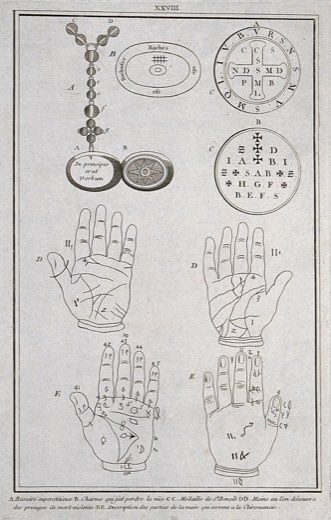
The Saint Benedict medal carries a whole exorcism in initials. In the arms of the cross: C S S M L, Crux sacra sit mihi lux, may the holy cross be my light; and N D S M D, Non draco sit mihi dux, let not the dragon be my guide. Round the edge: V R S N S M V, Vade retro Satana, nunquam suade mihi vana, begone Satan, never tempt me with vanities; and S M Q L I V B, Sunt mala quae libas, ipse venena bibas, what you offer is evil, drink your own poison. The letters were explained from a manuscript found at the abbey of Metten in Bavaria in 1647.
The Brown Scapular is the best known of all Catholic things worn. It belongs to the Carmelites: two small squares of brown wool joined by cords, worn under the clothes with one square on the breast and one on the back, a token of the brown habit of the order and of the protection of Our Lady of Mount Carmel. The tradition is that she appeared to the English Carmelite Simon Stock on the sixteenth of July 1251 and gave it to him with the promise that whoever died wearing it would not suffer eternal fire. A person is enrolled in it once by a priest, and wears it for life; a worn-out scapular is burned or buried and replaced without ceremony, and since 1910 a blessed medal may stand in for the cloth. Historians cannot trace the story of the vision earlier than the late fourteenth century, and the Church teaches it as a sign of a life lived in Mary's care and not as a charm that works by itself. Its feast is the sixteenth of July.
Chalking the door. At Epiphany, the sixth of January, the lintel is marked in blessed chalk with the year and three letters, as 20 + C + M + B + 27. The letters are the three kings, Caspar, Melchior and Balthasar, and also Christus mansionem benedicat, may Christ bless this house. It stays until it wears away.
Holy water and blessed salt are sprinkled at doors and windows and in the corners of a room. The old Roman rite for blessing water mixes the two and asks that wherever it is sprinkled “every unclean spirit” depart.
Church incense is frankincense, often with myrrh and benzoin. See incense.
The Psalms as charms
Jews and Christians have used the Psalms for practical ends for as long as there have been Psalms. The fullest handbook is the Hebrew Shimmush Tehillim, the Use of Psalms, which gives a purpose for every one. A German version of 1788 by Godfrey Selig, printed in English with the Sixth and Seventh Books of Moses, carried it into Pennsylvania Dutch powwow and Southern conjure, where it is still the working manual.
| Psalm | Opens | Used for, in that tradition |
|---|---|---|
| 4 | Hear me when I call | A turn of luck: said three times before sunrise |
| 23 | The Lord is my shepherd | To be shown the answer to a question in a dream, after fasting and washing |
| 91 | He that dwelleth in the secret place | Protection from every harm and from evil spirits; the great psalm of defence |
| 121 | I will lift up mine eyes unto the hills | Safety when travelling alone by night: said seven times |
Psalm numbers follow the Hebrew and King James count. Catholic Bibles made from the Latin number most of them one lower, so that Psalm 91 is their Psalm 90.
A word on borrowing
Saints travel. In Cuba, Brazil and Haiti, African divinities were honoured behind the faces of Catholic saints, and those religions have their own priests and their own rules; a saint's candle bought in a botanica may belong to that world and not to the parish church. Working with a saint as a Christian saint asks nothing of you but respect. For the orisha themselves, see The Gods.
Sources and further reading
- Carolyn Morrow Long, Spiritual Merchants: Religion, Magic, and Commerce (2001), for Saint Expedite and saint work in New Orleans.
- Jeffrey E. Anderson, Hoodoo, Voodoo, and Conjure: A Handbook (2008).
- Godfrey Selig, Secrets of the Psalms, printed with The Sixth and Seventh Books of Moses (English edition, 1880), which is in the public domain.
- Eamon Duffy, The Stripping of the Altars (1992), for how ordinary Christians used blessings, charms and saints before the Reformation.
- Prosper Guéranger, The Medal or Cross of Saint Benedict (1862; English 1880).

