The Gods · Egypt
Hathor
The Golden One; lady of the sycamore; mistress of the West
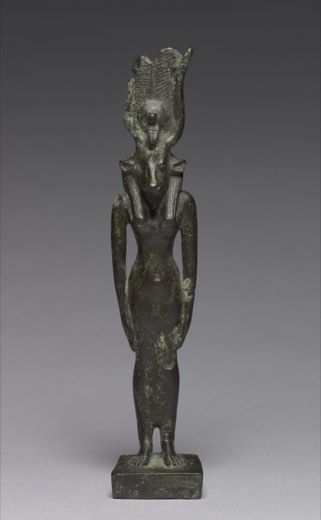
The goddess of everything that makes life sweet: love, music, dancing, perfume and wine. Her name means house of Horus. As a cow she nurses the king, and as lady of the West she receives the dead with food and drink. Her temple at Dendera kept a festival of drunkenness, remembering how the raging Eye of Ra was calmed with beer dyed red.
- Governs
- Symbols
- The cow; horns holding the sun disc; the sistrum rattle; the menat necklace; the mirror
- Honoured with
- Music, dancing, beer and wine, myrrh, mirrors
- Also
- Egyptian Ḥwt-Ḥr, Hut-Heru. Aphrodite to the Greeks.
- Ancient sources
- Coffin Texts; the Book of the Heavenly Cow; the temple texts of Dendera
For what this book says about offerings of smoke, see incense.
Further reading
- Richard H. Wilkinson, The Complete Gods and Goddesses of Ancient Egypt (2003).
- Geraldine Pinch, Egyptian Mythology: A Guide to the Gods, Goddesses, and Traditions of Ancient Egypt (2002).
- Erik Hornung, Conceptions of God in Ancient Egypt: The One and the Many (1982).
- Miriam Lichtheim, Ancient Egyptian Literature (three volumes, 1973 to 1980), for the texts in translation.
- Emily Teeter, Religion and Ritual in Ancient Egypt (2011).

