John Dee and the Angelic Conversations
19 May 2026
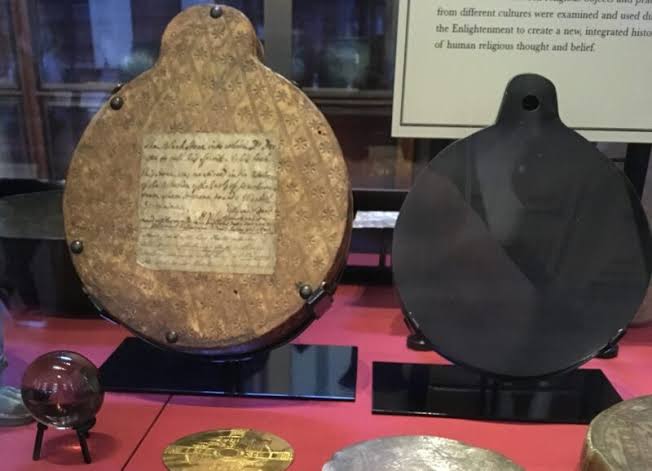
John Dee (1527–1608/9) was, by the standards of his own century, one of its great learned men: mathematician, adviser on navigation to the Elizabethan voyages, owner of the largest private library in England, consultant to the queen on the calendar and, on occasion, the auspicious date of her coronation. He is remembered instead for what he did in middle age: seven years of systematic conversation with angels, conducted through a crystal stone and a series of scryers, above all the brilliant and unreliable Edward Kelley, and recorded in thousands of pages of diaries that survive, improbably, to this day. The episode is the best-documented magical operation in Western history, and its documentation is precisely what makes it endlessly instructive.
The conversations
Dee did not consider himself a conjurer. He considered himself a natural philosopher who had exhausted books, and he petitioned God, in terms Job would recognize, for the kind of direct instruction the angels had given the patriarchs. From 1582, with Kelley gazing into the "shew-stone" and Dee recording, the sessions produced a vast structured revelation: a new angelic language with its own alphabet and syntax, later called Enochian; the forty-eight Claves Angelicae, the Enochian Keys, delivered letter by letter, backward, to defuse their power in transmission; the great lettered tables of the Watchtowers; and instructions for an angelic system of world-governance through the ninety-one Parts of the Earth. The manuscripts, part published by Casaubon's son Meric in 1659 as A True & Faithful Relation, went partly into a hidden drawer and a kitchen maid's pie-linings before reaching the British Library, a provenance story scholars have verified to a degree that would embarrass fiction.
What to make of it
The interpretive options are the standard three of spirit ontology, sharpened by an unusually rich record. The realist notes the system's structural coherence across years of sessions. The skeptic notes Kelley's documented talents for invention, and the sessions' drift toward the notorious 1587 "cross-matching" instruction that the two men share wives, precisely when Kelley wished to escape the work. The linguist notes that Enochian, analyzed by Donald Laycock, behaves less like a natural language than like glossolalia with English habits, and yet is internally consistent enough to resist easy dismissal. Dee's own diaries record his doubts, his tests, his anguish, a scrupulousness that is the episode's most moving feature: he wanted, above all, not to be deceived, and could not finally rule it out.
The afterlife
The angelic material slept for three centuries, then became the backbone of modern ceremonial magic: the Golden Dawn built its Watchtower rituals on Dee's tables (reworked past recognition, as Egil Asprem's study shows), Crowley took the Keys into Thelemic practice and scried the thirty Aethyrs in the Algerian desert in 1909, and "Enochian" is now a fixture of the ceremonial curriculum, several reconstructions deep. The working magician inherits both the system and the lesson of its source: keep the diary, test the spirits, and notice, as Dee teaches from four centuries away, that the medium through whom revelation arrives is part of the revelation's data.
Sources & Further Reading
- Meric Casaubon (ed.), A True & Faithful Relation of What Passed for Many Yeers Between Dr. John Dee ... and Some Spirits (1659).
- Deborah E. Harkness, John Dee’s Conversations with Angels (Cambridge, 1999).
- Stephen Clucas (ed.), John Dee: Interdisciplinary Studies in English Renaissance Thought (Springer, 2006).
- Egil Asprem, Arguing with Angels: Enochian Magic and Modern Occulture (SUNY, 2012).
- Donald C. Laycock, The Complete Enochian Dictionary (1978).
- Benjamin Woolley, The Queen’s Conjurer (Holt, 2001).
- Aleister Crowley, The Vision and the Voice (1911).