Occult Chemistry (1908): Clairvoyance Meets the Periodic Table
12 July 2026
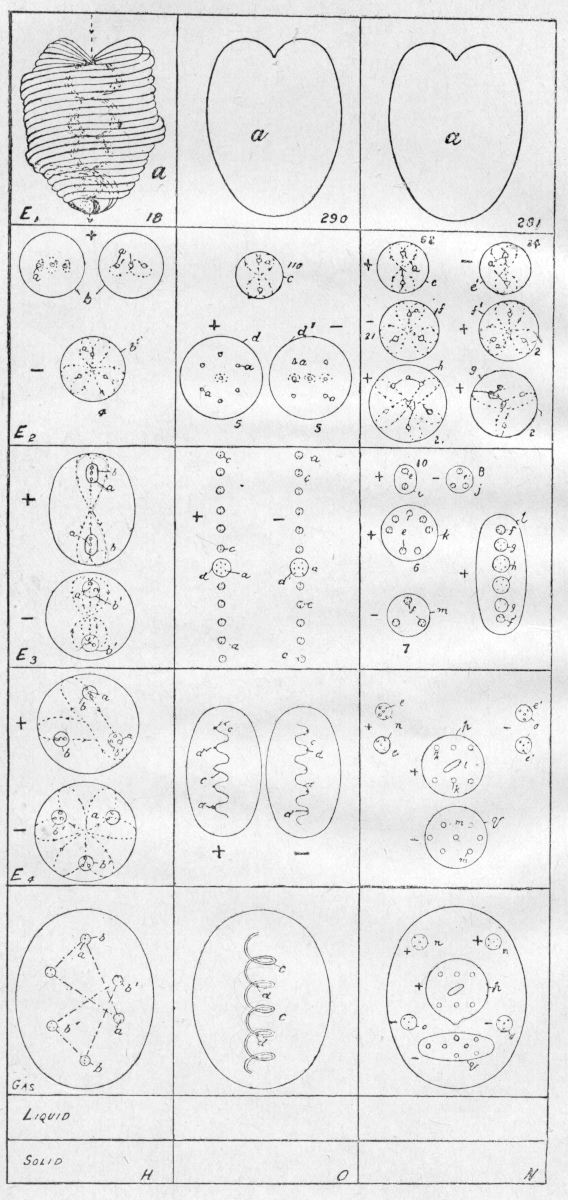
In 1908 Annie Besant and Charles Webster Leadbeater, the two most influential Theosophists of their generation, published one of the strangest books in the entire esoteric canon: Occult Chemistry: Clairvoyant Observations on the Chemical Elements. The premise is stated with complete seriousness in the preface: using a trained yogic faculty the authors called "magnifying clairvoyance," they had directly observed atoms, and the book reports what they saw, element by element, with diagrams. It is easy to laugh; it is more interesting to look closely, because the book is a perfect specimen of a recurring esoteric ambition, the fusion of occult method with scientific authority, caught at the exact historical moment when real physics was dissolving the atom itself.
What they reported
The observations began in 1895, when Besant and Leadbeater examined the air and reported the constituents of hydrogen, oxygen, and nitrogen; the 1908 book, expanded from articles in The Theosophist, extends the survey across dozens of elements, and the posthumous third edition (1951), compiled by Jinarajadasa, to the whole periodic table and beyond. What they describe is a physics of their own: all matter resolves into a fundamental particle they called the "ultimate physical atom" or anu, a heart-shaped vortex of spiral currents, spinning and pulsing, existing in positive and negative forms; the chemical elements are elaborate geometric arrangements, spheres, dumbbells, spikes, of these units, and the authors counted the units per element, deriving weights that track atomic weight surprisingly well, which is less mysterious once one notices the published weights were available to count toward. They also reported elements unknown to chemistry, including one they named "occultum," and isotopic variants they called meta-elements.
Context and reception
The timing is the poignant part. Between the observations and the book, real physics found the electron (1897), radioactivity, and the nuclear atom was two years away; the periodic table the clairvoyants were annotating was about to be re-founded on quantum numbers no siddhi had reported. Chemistry ignored the book. Within Theosophy it became a proof-text of clairvoyant method, and it has enjoyed a strange afterlife: a small literature, most notably by the physicist Stephen Phillips, has argued the observations anticipate quarks, an argument requiring, critics note, enough reinterpretation to fit almost anything. Historians of the movement read it now as Theosophy's boldest bid for scientific standing, and as an unintentional self-portrait: where Renaissance clairvoyance saw angels, the Edwardian seer saw particles, each age's visionaries observing, with suspicious fidelity, the furniture of its own science.
The lesson for the practitioner
This site takes the book seriously as a cautionary classic. Trained inner vision is real as a discipline, the imagery it yields is vivid, structured, and reproducible within a school, and none of that makes it a microscope. The Besant-Leadbeater failure mode, treating consensus-trained vision as instrument reading, is the standing hazard of every scrying tradition, which is why the older manuals insist on tests and the newer ones on the diary. As Dee's angels and Leadbeater's atoms jointly teach: the seer always sees something, and the discipline is in finding out what.
Sources & Further Reading
- Annie Besant and C. W. Leadbeater, Occult Chemistry: Clairvoyant Observations on the Chemical Elements (Theosophical Publishing Society, 1908; 3rd ed. 1951).
- C. Jinarajadasa, Occult Investigations (TPH, 1938).
- Stephen M. Phillips, Extra-Sensory Perception of Quarks (TPH, 1980), for the sympathetic rereading.
- Gregory Tillett, The Elder Brother: A Biography of Charles Webster Leadbeater (Routledge, 1982).
- Olav Hammer, Claiming Knowledge: Strategies of Epistemology from Theosophy to the New Age (Brill, 2001).
- Egil Asprem, The Problem of Disenchantment (Brill, 2014), on occult science claims.