The Wonders of Creation: al-Qazwini’s Cosmography
22 July 2026
Sometime around 1270, in Ilkhanid Iraq, the judge and scholar Zakariyyā ibn Muḥammad al-Qazwīnī completed a book whose title announces its ambition: Kitāb ʿAjāʾib al-makhlūqāt wa-gharāʾib al-mawjūdāt, "The Wonders of Creation and the Oddities of Existence." It became one of the most copied, translated, and illustrated books of the Islamic world, the Persian and Ottoman Turkish versions carrying it from the Balkans to Bengal, and its manuscripts are among the glories of Islamic painting. It is remembered loosely as a "medieval bestiary," which undersells it badly: the ʿAjāʾib is a complete cosmography, a guided tour of everything, arranged from the highest heaven downward, and its organizing emotion is the one its title names: ʿajab, wonder, the astonishment owed to a creation in which everything is a sign.
The architecture of everything
The book falls in two great halves. The supralunar: the spheres, the planets, the fixed stars and their images, the inhabitants of the heavens, with a full angelology, the bearers of the Throne, Gabriel, Michael, the recording angels, treated with the same descriptive care as the geography. Then the sublunar: the calendar and its festivals; the elements; the seven climes; the seas with their islands and marvels; minerals, plants, and animals, ordered kingdom by kingdom, each entry mixing observation, medicine, and the properties (khawāṣṣ) of things, the useful virtues that shade into natural magic. And threaded through the lower world, the beings this site's readers will recognize as the crowded middle: the jinn and their tribes, the ghūl of the wastes, the giant bird ʿAnqāʾ, the sea-peoples, treated neither as doctrine nor as fancy but as reported inhabitants of a wide creation, with al-Qazwini often citing his chains of sources and sometimes registering his own doubt.
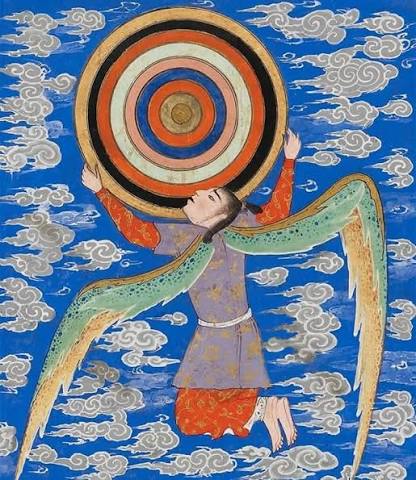
Wonder as method
The preface is the book's real thesis: al-Qazwini defines ʿajab as the perplexity that befalls a person confronted with something whose cause they do not know, and prescribes contemplation of wonders as a spiritual exercise, since every marvel points to its Maker. This is worth sitting with, because it names a stance our own tradition keeps circling: the cultivated astonishment that animism practices as etiquette and that the naturalist practices as attention, here systematized as devotion. The book's jinn-lore also supplied the learned frame for the Islamic world's practical spirit-work, the talismans and conjurations of which the Picatrix is the exported example; cosmography and operation were two shelves of one library.
Reading it now
No complete English translation exists, a standing scandal of the field, but the reader can assemble the book from the scholarship: Persis Berlekamp's study of the illustrated manuscripts, Travis Zadeh's work on the wonder tradition, and the older German translation by Ethé. The manuscripts themselves are increasingly digitized, and browsing one, angels, ʿAnqāʾ, onions, and all, is the best available way to feel what the book is: a reminder, from the tradition that gave Europe half its magic, that the catalogue of the world and the book of marvels were once, correctly, the same book.
Sources & Further Reading
- Zakariyyā al-Qazwīnī, ʿAjāʾib al-makhlūqāt wa-gharāʾib al-mawjūdāt (c. 1270); partial German trans. Hermann Ethé (1868).
- Persis Berlekamp, Wonder, Image, and Cosmos in Medieval Islam (Yale, 2011).
- Travis Zadeh, Wonders and Rarities: The Marvelous Book That Traveled the World and Mapped the Cosmos (Harvard, 2023).
- Syrinx von Hees, "The Astonishing: A Critique and Re-reading of ʿAǧāʾib Literature," Middle Eastern Literatures 8:2 (2005).
- Amira El-Zein, Islam, Arabs, and the Intelligent World of the Jinn (Syracuse, 2009).
- Stefano Carboni, The Wonders of Creation and the Singularities of Painting (Edinburgh, 2015).